Alkalinity
Quick Definition:
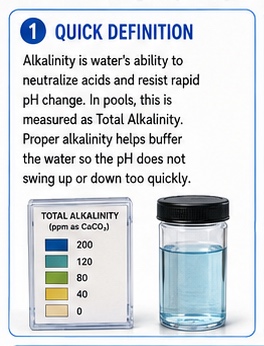
Alkalinity measures the acid-neutralizing capability of swimming pool water.
What is Alkalinity?
Alkalinity describes the ability of water to neutralize acids. Water that has higher alkalinity can be said to be more alkaline. In swimming pools, alkalinity is usually discussed and measured as Total Alkalinity (TA).
The more alkaline the water, the more the water is able to accept protons, usually hydrogen ions, and the better it can resist a rapid drop in pH when acids are intentionally or unintentionally added to the pool water. This buffering action helps protect the pool from rapid or repeated pH movement sometimes described as pH bounce.
For a pool owner, the simplest way to think about alkalinity is as a chemical cushion for pH. Proper alkalinity does not eliminate pH changes, but it helps the water resist sudden changes so pH is easier to keep within a stable range.
What Does Alkalinity Do in a Swimming Pool?
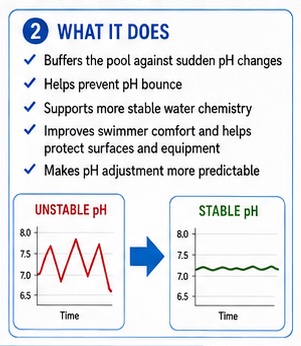
Alkalinity helps buffer pool water against sudden pH changes. When alkalinity is maintained at an appropriate level, the water is less likely to experience large, rapid swings in pH and is generally more predictable to manage.
- Buffers the pool against sudden pH changes.
- Helps prevent pH from bouncing rapidly up and down.
- Supports more stable and predictable water chemistry.
- Can make routine pH adjustment easier to manage.
- Supports swimmer comfort and helps protect pool surfaces and equipment when the overall water balance is maintained.
How Alkalinity Buffers pH
The buffering effect of alkalinity is closely associated with bicarbonate, carbonate, and related alkaline compounds in the water. When acid supplies hydrogen ions (H+), the bicarbonate/carbonate system can help absorb some of that change. The result is a pool whose pH tends to move more gradually instead of changing as sharply.
This is why alkalinity and pH are closely related but are not the same measurement. pH describes the current acidic or basic condition of the water, while alkalinity describes the water’s capacity to neutralize acid and resist rapid pH change.
Total Alkalinity is commonly measured in parts per million (ppm) as calcium carbonate (CaCO3). The supplied alkalinity reference material shows a typical pool target of approximately 80–120 ppm.
Low, Ideal, and High Alkalinity
Low Alkalinity
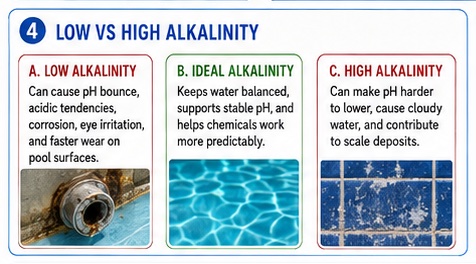
When Total Alkalinity is too low, the pool has less buffering capacity. That can allow pH to bounce more easily and can contribute to acidic tendencies. The supplied pool-owner guidance also associates low alkalinity with corrosion, eye irritation, and faster wear on pool surfaces.
Ideal Alkalinity
When Total Alkalinity is kept in the desired range, the water is better buffered, pH tends to remain more stable, and routine chemical adjustments can behave more predictably. Stable alkalinity is therefore an important part of maintaining balanced swimming pool water.
High Alkalinity
When Total Alkalinity is too high, pH may become harder to lower and may tend to drift upward. The supplied guidance also notes that high alkalinity can contribute to cloudy water and scale deposits.
Typical Pool Water Balance Targets
Alkalinity should not be considered by itself. Pool owners use Total Alkalinity together with other key water measurements to understand the overall condition of the pool. The supplied reference image presents the following typical balance targets:
| Measurement | Typical Range Shown |
|---|---|
| pH | 7.2–7.8 |
| Total Alkalinity | 80–120 ppm |
| Calcium Hardness | 200–400 ppm |
| Free Chlorine | 1–3 ppm |
| Cyanuric Acid (Stabilizer) | 30–50 ppm |
The important point for pool owners is that Total Alkalinity is one part of the larger water-balance picture. A good alkalinity reading helps stabilize pH, but the pool should still be tested and maintained using the other important water measurements as well.
When Should You Test or Adjust Total Alkalinity?
Total Alkalinity should be included in routine pool-water testing. The supplied pool-owner guidance highlights several situations when checking alkalinity is especially useful:
- During routine weekly water testing.
- When pH keeps drifting or bouncing.
- After heavy rain, refill water, or large chemical additions.
- When the water becomes cloudy or scaling begins to appear.
- When the pool feels difficult to balance.
If pH repeatedly moves in unexpected directions, Total Alkalinity is one of the key measurements to check because inadequate or excessive alkalinity can make pH management more difficult.
Benefits of Keeping Alkalinity in Range
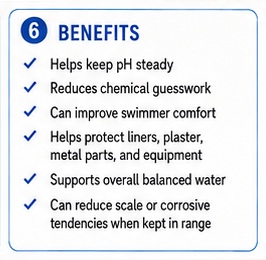
Maintaining Total Alkalinity in the desired range can make the pool easier to manage because it supports pH stability and reduces some of the guesswork involved in water-balance adjustments.
- Helps keep pH steady.
- Reduces chemical guesswork.
- Can improve swimmer comfort.
- Helps protect liners, plaster, metal parts, and equipment as part of proper water balance.
- Supports overall balanced pool water.
- Can reduce scale-forming or corrosive tendencies when alkalinity is kept in an appropriate range.
How to Manage Total Alkalinity
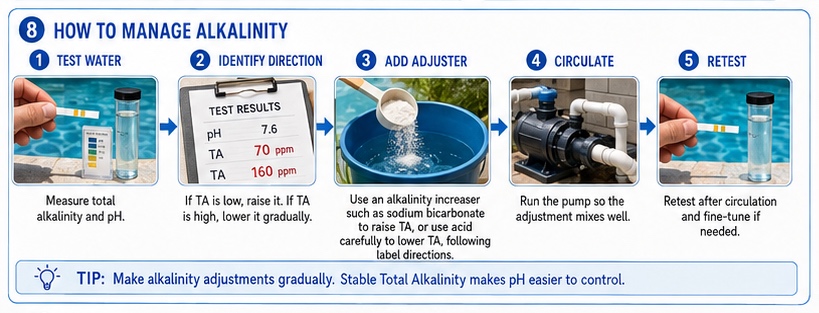
The above is a simple five-step process for managing alkalinity. The goal is to measure first, determine whether Total Alkalinity needs to move up or down, make the adjustment carefully, allow the pool water to circulate, and then retest.
1. Test the Water
Measure both Total Alkalinity and pH so you know the current condition of the water before making an adjustment.
2. Identify the Direction of the Adjustment
If Total Alkalinity is low, it needs to be raised. If it is high, it needs to be lowered gradually. Looking at alkalinity and pH together helps the pool owner understand what adjustment is needed.
3. Add the Appropriate Adjuster
For low Total Alkalinity, the supplied guide identifies an alkalinity increaser such as sodium bicarbonate. For high Total Alkalinity, it indicates that acid can be used carefully to lower the level. In either case, follow the product label directions and make changes gradually.
4. Circulate the Water
Run the pool pump so the treatment mixes through the pool water.
5. Retest
After the water has circulated, test again and fine-tune the water only if needed. Gradual adjustments make it easier to avoid overshooting the desired range.
Pool-owner tip: Make alkalinity adjustments gradually. Stable Total Alkalinity makes pH easier to control.
Warnings & Pool Safety Precautions
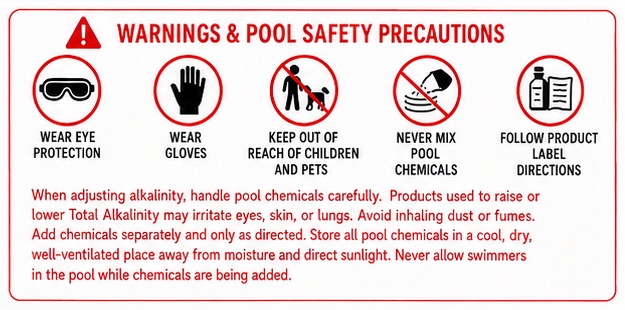
Adjusting alkalinity can involve pool chemicals that should be handled carefully. Products used to raise or lower Total Alkalinity may irritate the eyes, skin, or lungs. Follow the product label and the safety directions supplied with the chemical you are using.
- Wear eye protection.
- Wear gloves.
- Keep pool chemicals out of reach of children and pets.
- Never mix pool chemicals together.
- Follow product label directions.
- Avoid inhaling dust or fumes.
- Add chemicals separately and only as directed.
- Store pool chemicals in a cool, dry, well-ventilated place away from moisture and direct sunlight.
- Do not allow swimmers in the pool while chemicals are being added.
Why Alkalinity Matters to Pool Owners
Swimming pool owners need to understand alkalinity because it directly affects how resistant the pool water is to rapid pH change. Measuring Total Alkalinity gives the owner a practical way to evaluate that buffering capacity and to determine whether the pool is likely to remain easier to balance.
Low alkalinity can make pH more unstable, while high alkalinity can make pH harder to lower and can contribute to cloudy water or scale. Keeping Total Alkalinity in its intended range helps make water chemistry more predictable and helps maintain balanced pool water.
For routine maintenance, think of alkalinity as one of the pool’s key stabilizing measurements: test it regularly, watch it when pH begins to drift or bounce, adjust it gradually when needed, circulate the water, and retest before making additional changes.
Coming soon to you in 2026...
A Pool Owner's Guide to help you Manage Pool Alkalinity easier, less costly, and with more confidence. Read more below...