Testing Swimming Pool pH
How to test your swimming pool water pH level, discussing the different ways to test, along with tips and suggestions on how to manage your pool pH.
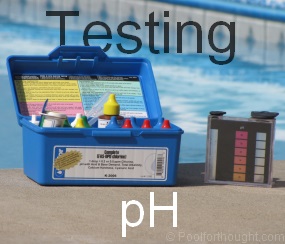
How to test your swimming pool water pH level, discussing the different ways to test, along with tips and suggestions on how to manage your pool pH.
A buffer is a chemical addition to swimming pools, usually sodium bicarbonate, which increases the ability of the water to resist rapid fluctuations in pH when adding acids or bases to the pool water.
Bromine is an acceptable sanitizing chemical used in swimming pools.
Blue-green algae can appear in swimming pools, and is more difficult to eliminate than other types of algae like green or mustard algae.
Black (also called blue-green) algae can appear in pools, often as small round dark spots at or near crevices, cracks, and shaded areas of the pool.
Bather load is a pool industry term to describe the amount of swimmers, or bathers, in a pool at any given time or during a given time span.
Adding a base to pool water will cause the water to become more basic. Pools that contain too much of a base can cause cloudy water and pool surface scaling.
Baking soda is also called sodium bicarbonate and is used to raise the alkalinity of swimming pool water.
Bacteria are small living organisms that can be found in pools, although a pool that is well sanitized should consistently keep bacteria counts below unsafe levels.
Backwashing is the process of cleaning the main swimming pool filter by reversing the flow of water through the filter, dislodging filter debris and removing the debris-filled water from the pool lines, leaving a cleaned filter.